Follow a material
From Copper to Compute
Follow copper from a mine in Zambia to the equipment that powers AI.
5 scenesAbout 5 minutes
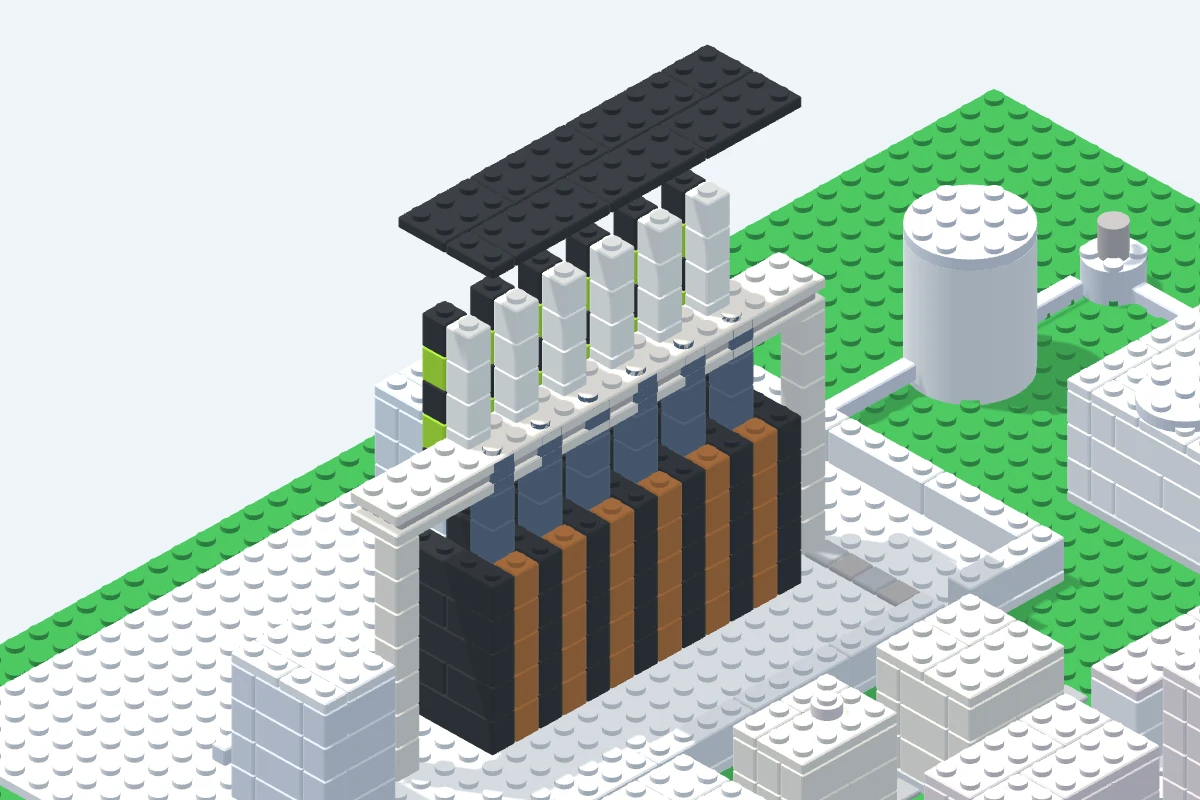
A busbar distributes electrical power to the computers.
Stylized building blocks; shapes and colours are illustrative.
01 / Inside the data centre
AI needs a
physical connection.
This copper bar carries electricity to the computers. It is called a busbar.
Its broad shape gives a large electrical current room to flow without getting too hot. Connections along the bar deliver power to the server shelves.
Across our representative 1-gigawatt AI plant, copper appears in cables, transformers, cooling equipment and connections like this one.
About 16,900 tonnes of copper across the modeled equipment.
Run 04 base estimate for the equipment covered by the model.
Current 1 GW equipment model, Run 04 base case → · How we calculated this journey →
Where does that much copper begin?
Let’s go back to a mine in Zambia.
Representative example The busbar is one component in our hypothetical plant.
What does 1 gigawatt mean?
One gigawatt is one billion watts of power.
Imagine one million appliances each drawing 1,000 watts, all switched on together. That is the electrical demand we use for the computers in this reference plant. Cooling and other supporting systems need additional power.
The copper total is an estimate for the equipment covered by our model. Different plant designs use different quantities.
The Run 04 base case covers equipment blocks B1–B3: power, compute and cooling. Civil works and unallocated offsite infrastructure are outside this estimate.
Go deeper: the complete circuit
Power needs a return path too. Real rack assemblies have separate power and return conductors, supports and connections. The brick model simplifies that construction.
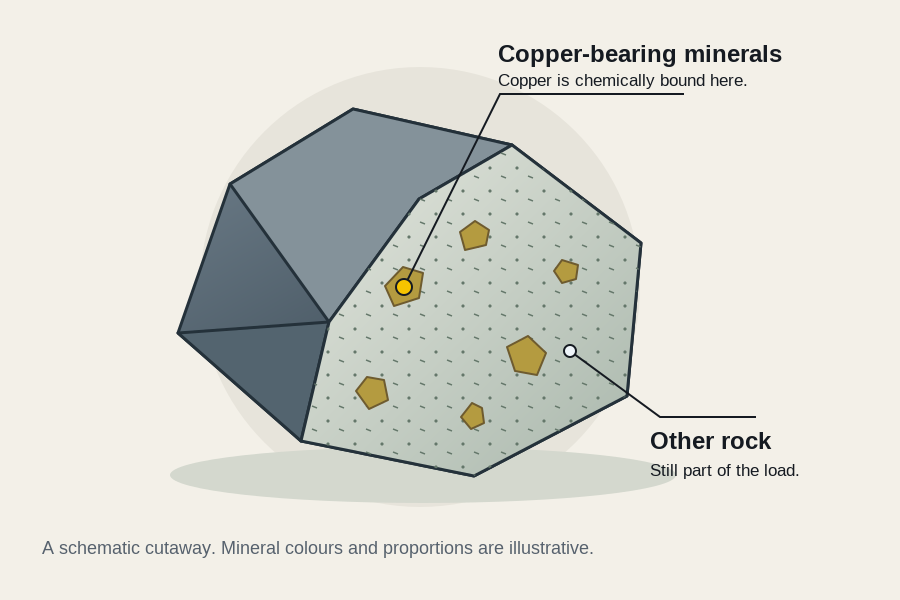
In 1 kg of this ore, about 3.9 grams is copper, held inside minerals.
Illustrative cutaway. Copper content uses Sentinel’s 2025 average ore grade; mineral shapes and proportions are schematic.
02 / At the mine
A little copper.
A lot of rock.
Copper is held inside minerals scattered through the rock.
In the example we’re following, a kilogram of ore contains about 3.9 grams of copper. That is less than half of one percent of its weight.
Rock worth processing for its metal is called ore. To reach it, an open-pit mine also moves surrounding waste rock.
About 17 million tonnes of rock moved.
Estimated mining to supply our plant’s copper through this representative route.
How long would that take?
About five weeks at a large mine’s working pace.
Zambia’s Sentinel mine moved roughly 466,000 tonnes of ore and waste rock per day, averaged across 2025. Our example represents about 37 days of work at that rate.
Calculated from First Quantum 2025 annual report, p. 32 → · How we calculated this journey →
For every 1 kg of finished copper
This example begins with approximately:
- 300 kg of ore sent for processing.
- 700 kg of waste rock moved to reach the ore.
How big is 17 million tonnes?
A giant mining truck such as a Caterpillar 793 can carry about 240 tonnes.
Seventeen million tonnes is equivalent to roughly 71,000 full truckloads of that size.
The truck is a size comparison. The mining quantities use Sentinel’s reported 2025 operating figures.
Selected 240-tonne rated-payload configuration. Caterpillar 793 payload → · First Quantum 2025 annual report, p. 32 →
Why this mine?
Sentinel gives us a documented example of a large Zambian open-pit copper mine.
Its ore grade, processing results and mining volumes let us calculate a representative journey. Other mines can produce the same amount of copper from very different quantities of rock.
Even the same mine changes over time. Using Sentinel’s 2024 figures, our calculation falls to about 12 million tonnes of rock moved. Ore grade and the amount of waste rock both make a substantial difference.
First Quantum 2025 annual report, p. 32 → · How we calculated this journey →
Around the world: where copper is mined
Who pays? Before the rock becomes metal
Typical industry practice
- What is sold?
- A mine with a concentrator can sell concentrate to a smelter. Some companies also operate smelters and refineries, taking the copper further themselves.
- What comes first?
- Mine development, equipment and the work of mining and concentrating ore must be funded before the product is sold.
- What could stop it?
- The ore must yield enough recoverable copper. Power, processing capacity and transport must be available.
An integrated example: concentrate transported to a smelter → · Financing costs before customer payment →
- Ore
- Concentrate
- Anode
- Cathode
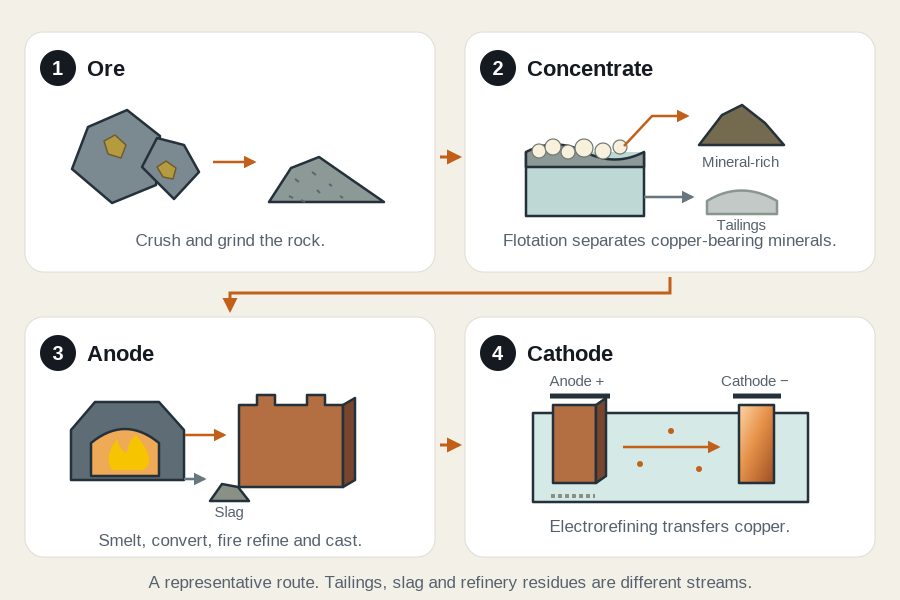
Four states take copper from minerals to a refined metal sheet.
Representative process. Tailings and slag are different materials left behind at different stages.
03 / Recover the copper
Keep the
copper moving.
The ore contains copper mixed with millions of tonnes of other material. Each stage separates more of it.
Crush and grind
Large rocks become small particles, freeing copper-bearing minerals so they can be separated.
Our example sends about 5.1 million tonnes of ore through this stage.
That is about 34 days of Sentinel’s average milling throughput in 2025.
First Quantum 2025 annual report, p. 32 → · How we calculated this journey →
Concentrate
In a process called flotation, bubbles carry selected mineral particles into a froth. This produces concentrate.
A kilogram of our starting ore contains about 4 grams of copper. A kilogram of the concentrate contains about 235 grams.
The concentrate is much richer in copper.
Our plant’s requirement corresponds to about 74,000 tonnes of concentrate.
First Quantum 2025 annual report, p. 32 → · How we calculated this journey →
Smelt
Heat and chemical reactions turn the copper minerals into copper metal. Other material separates into slag or leaves in gases that require treatment.
The metal is refined further and cast into thick plates called anodes.
Our concentrate quantity represents about 22 days of the Kansanshi smelter’s average 2025 throughput.
First Quantum 2025 annual report, p. 29 → · Smelting to anodes →
Refine
Electricity moves copper from the anodes, through a liquid, onto new sheets called cathodes. Impurities separate from the copper. This is electrorefining.
Mopani’s refinery in Zambia reports cathodes containing 99.999% copper.
In a kilogram of that metal, only about 10 milligrams consists of impurities.
Now we have copper ready for manufacturing.
Representative supply scenario The mine, smelter and refinery examples explain different stages. They do not establish one shipment through these operations.
What stays behind?
Most of the ground ore leaves flotation as tailings.
For every kilogram of finished copper in this example, about 304 kg of ore enters processing. Roughly 300 kg leaves as dry tailings, while about 4.4 kg continues as concentrate.
Across the plant’s copper requirement, that means about 5.1 million dry tonnes of tailings. Water mixed with those solids adds to the material handled on site.
The tailings come from ore already counted in the mining total. Ore and tailings both round to 5.1 million tonnes here; the concentrate removed makes the tailings quantity smaller.
Smelting produces slag, another material requiring management. Some copper remains in these streams and may be recovered through further processing.
How we calculated this journey → · Smelter process description →
Another route through liquid
Some ores follow a different route.
Acid dissolves copper into a liquid. Further processing separates and concentrates the dissolved copper. Electricity then deposits it onto cathodes.
This is called leaching, solvent extraction and electrowinning.
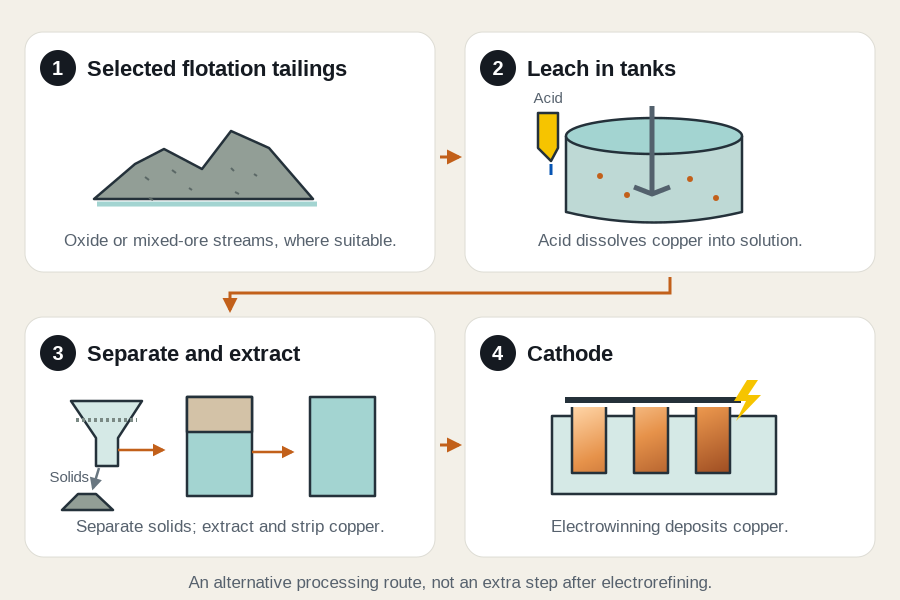
The illustrated Zambian example uses acid-leaching tanks for selected oxide or mixed-ore flotation tailings. Electrorefining starts with a copper anode; electrowinning recovers copper from liquid.
The main journey’s quantities describe a sulphide-ore route through flotation and smelting. The liquid route has its own material and energy requirements.
Around the world: where copper is processed
Who pays? A usable metal
Typical industry practice
- What is sold?
- Refined copper to an agreed specification, bought by metal customers such as fabricators.
- What comes first?
- Processing equipment, reagents, electricity and labour must be paid for while copper is being recovered.
- What could stop it?
- Recovery performance, product quality and reliable power affect whether saleable metal is ready.
A saleable product: refined cathodes → · Working capital →
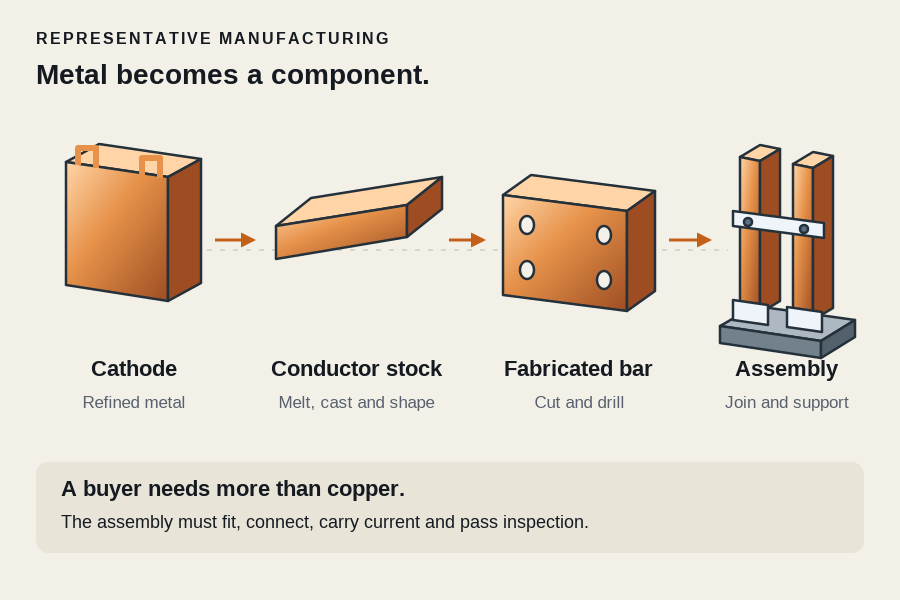
The metal needs a shape, secure connections, support and checks.
Representative fabrication and assembly.
04 / Make the component
Give the copper
a job.
A copper sheet still needs to become something useful.
A manufacturer melts and casts copper into stock, then shapes it into a conductor. A fabricator cuts it to length and makes the holes, bends and contact surfaces required for its connections.
For this busbar, shape matters.
Its thickness and width help determine how much current it can carry. Its connections must fit the equipment. Supports hold it in place and keep conductors separated.
From refined metal to a component built to carry power.
The plant’s copper takes many forms. This busbar is one example among its cables, transformer windings and other equipment.
Copper for Busbars, chapters 5–6 → · One manufacturer’s forming route →
What happens to the offcuts?
Cutting and shaping copper creates offcuts and other scrap.
Manufacturers can collect that material for recycling. Some copper returns to melting and casting.
Our representative calculation assumes the modeled copper comes from newly mined material. Actual products can also contain recycled copper.
Copper fabrication and recycling → · How we calculated this journey →
Around the world: where copper becomes products
Who pays? More than the copper
Typical industry practice
- What is sold?
- A specified conductor or assembly, typically to an electrical-equipment maker or system integrator.
- What comes first?
- Copper stock, tooling, production labour and inspection. Working capital bridges spending and customer receipts; payment arrangements vary.
- What could stop it?
- A part that fails dimensional, electrical or inspection requirements may not be accepted, even if its copper is valuable.
The tangible difference: a metal seller delivers copper to specification. A component maker must also deliver the right shape, connections and evidence of quality.
Luvata: specifications and inspection documents → · EXIM: an exporter financing example →
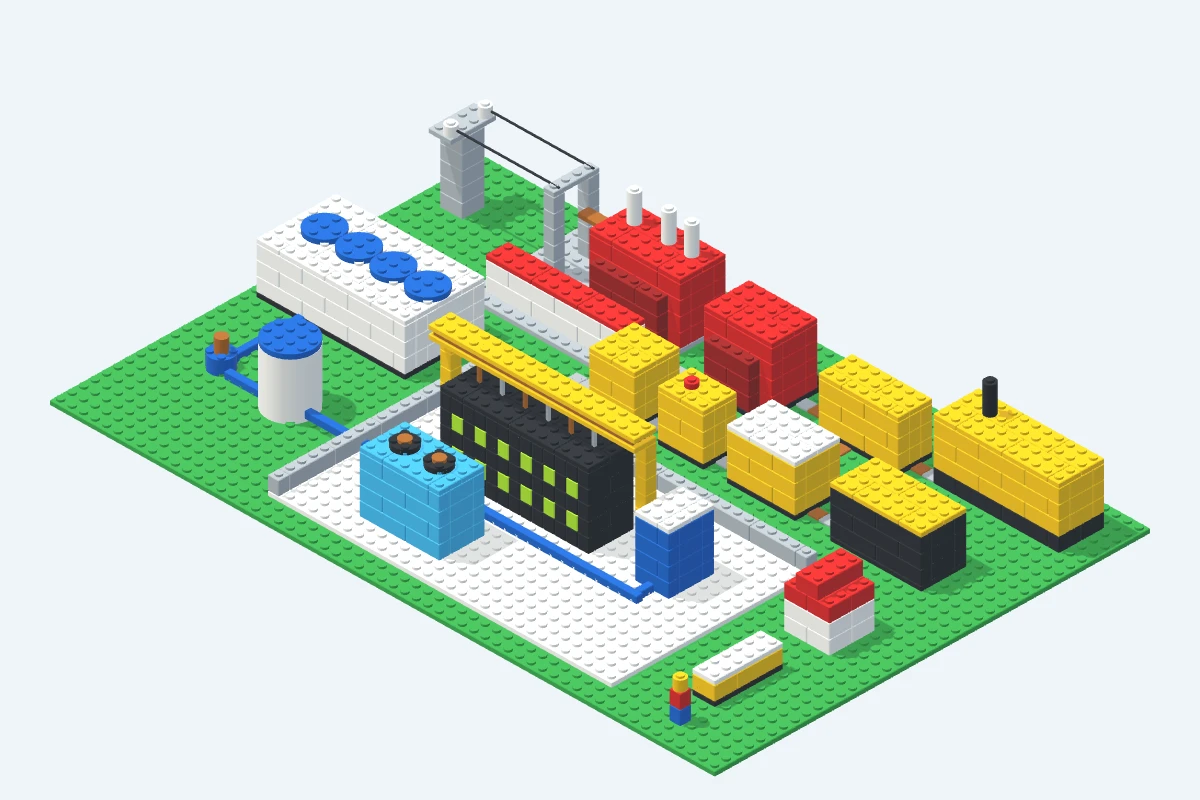
The copper’s journey ends where the computers’ work begins.
Representative installation in a hypothetical facility. The model’s 1 GW describes commissioned IT electrical capacity.
05 / Install it
Back in place.
Ready to carry power.
The busbar joins the rack’s power system.
Its connections are secured and inspected. Together with the rest of the electrical equipment, it provides a path for power to reach the computers.
Follow this one component backwards and the industrial scale comes into view.
| Stage | Representative quantity |
|---|---|
| Rock moved at the mine | About 17 million tonnes |
| Ore crushed and ground | About 5.1 million tonnes |
| Concentrate sent to smelting | About 74,000 tonnes |
| Copper in the modeled equipment | About 16,900 tonnes |
These are stages along the same journey. The ore is part of the rock moved. The concentrate comes from that ore.
About five weeks of a large mine’s activity, represented in the copper that helps this plant run.
Calculated from Current 1 GW equipment model, Run 04 base case → and First Quantum 2025 annual report, p. 32 →. Assumptions below.
Explore copper across the modelHow we calculated this journey
This is a representative supply scenario for the copper in our 1 GW equipment model.
The starting requirement is approximately 16,900 tonnes of copper-grade stock, treated here as an equivalent quantity of refined copper. It is the Run 04 base estimate for equipment blocks B1–B3, covering power, compute and cooling. It excludes civil works and unallocated offsite infrastructure.
We use:
- Sentinel’s 2025 ore grade of 0.39% copper.
- Its reported 87% copper recovery into concentrate.
- Its concentrate grade of 23.5% copper.
- Its annual ratio of approximately 2.33 tonnes of waste rock per tonne of ore mined.
- Kansanshi’s reported 2025 smelter copper recovery of 98%.
- An assumed 99% net refining recovery.
We assume all the copper comes from newly mined ore and apply no additional net fabrication loss.
Applying the mine’s annual waste-to-ore ratio to the modeled processing requirement gives an approximate mining total. Stockpiles and mine development affect when the rock is actually moved.
The processing quantities describe dry material. Water, fuel, reagents and other supporting inputs would add further flows.
The 2024 comparison changes only the mine figures: 0.51% ore grade, 88% copper recovery and approximately 2.13 tonnes of waste rock per tonne of ore mined. The plant requirement and downstream recovery assumptions stay the same.
What do the time comparisons mean?
The days express how much of an operation’s throughput our example would use.
Mining, milling, smelting and refining happen alongside one another, with storage and transport between them. Each time comparison describes one stage’s capacity. Delivery time also depends on scheduling, transport and available capacity.
The mine and smelter comparisons use actual 2025 annual throughput divided by 365.
Sources
Around the world: where copper ends up
Sources and a real-world AI copper agreement
The main journey combines the current equipment model with Sentinel’s operating figures and representative smelting, refining, manufacturing and installation. Its quantities describe a supply scenario, rather than a procurement record. The source register records what each reference supports and its limits.
Publicly documented In January 2026, Rio Tinto and AWS announced an agreement for Nuton copper from Johnson Camp Mine in Arizona to be used in US data-centre components. That mine uses a different processing route from the Zambian examples shown here.
Not publicly disclosed The reviewed sources do not identify the component manufacturer, installed component or destination facility. Gunnison says the mine supplies AWS, but we found no AWS-specific shipment receipt or installation record. The agreement documents an intended use; it does not trace the busbar pictured here.
Rio Tinto agreement → · Gunnison supply statement → · Production and general sales update →